What Is a Good Conversion Rate for a B2B Website in 2026?

.svg)
Table of Contents
Most agencies will tell you "it depends" and leave it there. That's technically true and completely useless if you're the one staring at Google Analytics trying to figure out whether your 1.8% is fine or a five-alarm fire.
Here's the actual answer: it depends on where the visitor came from and what you're asking them to do. Once you split your numbers that way, "good" gets a lot easier to define. We've pulled these benchmarks from the Webflow rebuilds we've run for B2B and SaaS companies over the last few years, so treat them as a starting point, not gospel.
First, decide what counts as a conversion
Not every B2B site is chasing the same action. A demo booking, a contact form fill, a content download, and a free trial signup all convert at different rates and mean very different things for revenue.
Demo requests are the standard for mid-market SaaS. Across total site traffic, 1 to 3% is normal. If your traffic is high-intent (people who searched for exactly what you do), 3 to 5% is achievable. Below 1% on meaningful volume means something upstream is broken, not that demos are just a hard ask.
Contact form submissions run higher, usually 2 to 5%, because the commitment is smaller. But not all contact forms are equal. A bare "get in touch" box pulls in a lot of noise. A form with two or three qualifying questions filters for people who are actually ready to talk, which matters more than the raw number.
Mixing these two together and reporting one blended "site conversion rate" is how teams end up optimizing for the wrong thing.
The number that actually matters: conversion by traffic source
This is the part most B2B teams skip, and it's the single biggest lever we've found in site audits.
A 0.5% conversion rate from organic blog traffic is completely fine. Those visitors are researching, not buying, and pushing them into a demo form is like proposing on a first date.
A 0.5% conversion rate from branded search, people who typed your company name into Google, is a real problem. They already know who you are. They came looking for you on purpose. If they land on your site and leave anyway, the site is losing a warm lead for free.
Paid traffic sits in between and depends heavily on targeting. A tightly targeted LinkedIn campaign to your actual ICP landing on a page built for that offer should convert around 2 to 4%. Broad awareness campaigns will always look worse, and that's not a site problem, it's an expectations problem.
Stop asking "what's my conversion rate." Start asking "what's my conversion rate for this specific source." That's where you'll find the leak.
What separates the top B2B sites from the rest
We've now audited enough sites to see the same handful of things show up again and again on the ones that consistently beat benchmark.
The CTA is specific, not generic. "Book a 30-minute audit, we'll review your site live and tell you what's broken" outperforms "Book a demo" almost every time. Specificity lowers the anxiety of not knowing what you're agreeing to.
Social proof has a name attached. "Rahul Krishnan, Head of Marketing at Toplyne" beats a row of five-star icons with no attribution. B2B buyers are skeptical by default. Anything that looks like it could've been made up gets discounted on sight, fairly or not. You can see this play out in how we handled proof on the Superleap and Try Draftt rebuilds.
The site is fast. Every second of load time past two seconds costs you conversions in a measurable, predictable way, roughly 20% of would-be converters gone by the three-second mark. This isn't a copy problem. It's a build problem, and no amount of clever CTA writing fixes it.
There's exactly one next step. Not three competing buttons in the hero. One. Every additional CTA quietly cannibalizes the others, and the site ends up converting worse across the board than if it had just picked one thing to ask for.
Five things that are probably costing you conversions right now
Your headline talks about you, not your buyer's problem. "We help companies achieve their digital potential" doesn't describe anything a real person is dealing with. "Your website is losing you deals" does. One gets skimmed past, the other makes someone stop scrolling.
Your proof is generic or unverifiable. Logos with no context, testimonials with no name attached, review counts you can't click through to source. All of it reads as manufactured, even when it isn't.
Your site is genuinely slow. Run your homepage through Google PageSpeed Insights right now. Below 70 on mobile means you have a structural problem, and no headline rewrite will fix it.
Tracking is quietly broken. This one gets missed constantly. If your form doesn't fire the right event, or your CMS pages aren't tagged the same way as your marketing pages, your "conversion rate" isn't wrong, it's fictional. Fix measurement before you fix copy.
Mobile is an afterthought. Over half of B2B research now happens on mobile. If your site was designed for desktop and just "adjusts" on a phone, you're losing half your audience before they even read your headline.
How to check your own site in the next 30 minutes
Open Google Analytics and pull your top five landing pages by sessions. Look at each one's conversion rate individually, not the site-wide average. For every underperformer, ask three questions: is this page getting commercial-intent traffic or research traffic, what's the load time, and is there one obvious next step or five competing ones.
That'll tell you more in half an hour than any industry benchmark will.
If you want a second set of eyes on it, our free audit call walks through exactly this, live, on your actual site and your actual traffic. We'll show you where the leak is whether or not you end up working with us. You can see the kind of work that comes out the other side in our case studies.
Here's the actual answer: it depends on where the visitor came from and what you're asking them to do. Once you split your numbers that way, "good" gets a lot easier to define. We've pulled these benchmarks from the Webflow rebuilds we've run for B2B and SaaS companies over the last few years, so treat them as a starting point, not gospel.
First, decide what counts as a conversion
Not every B2B site is chasing the same action. A demo booking, a contact form fill, a content download, and a free trial signup all convert at different rates and mean very different things for revenue.
Demo requests are the standard for mid-market SaaS. Across total site traffic, 1 to 3% is normal. If your traffic is high-intent (people who searched for exactly what you do), 3 to 5% is achievable. Below 1% on meaningful volume means something upstream is broken, not that demos are just a hard ask.
Contact form submissions run higher, usually 2 to 5%, because the commitment is smaller. But not all contact forms are equal. A bare "get in touch" box pulls in a lot of noise. A form with two or three qualifying questions filters for people who are actually ready to talk, which matters more than the raw number.
Mixing these two together and reporting one blended "site conversion rate" is how teams end up optimizing for the wrong thing.
The number that actually matters: conversion by traffic source
This is the part most B2B teams skip, and it's the single biggest lever we've found in site audits.
A 0.5% conversion rate from organic blog traffic is completely fine. Those visitors are researching, not buying, and pushing them into a demo form is like proposing on a first date.
A 0.5% conversion rate from branded search, people who typed your company name into Google, is a real problem. They already know who you are. They came looking for you on purpose. If they land on your site and leave anyway, the site is losing a warm lead for free.
Paid traffic sits in between and depends heavily on targeting. A tightly targeted LinkedIn campaign to your actual ICP landing on a page built for that offer should convert around 2 to 4%. Broad awareness campaigns will always look worse, and that's not a site problem, it's an expectations problem.
Stop asking "what's my conversion rate." Start asking "what's my conversion rate for this specific source." That's where you'll find the leak.
What separates the top B2B sites from the rest
We've now audited enough sites to see the same handful of things show up again and again on the ones that consistently beat benchmark.
The CTA is specific, not generic. "Book a 30-minute audit, we'll review your site live and tell you what's broken" outperforms "Book a demo" almost every time. Specificity lowers the anxiety of not knowing what you're agreeing to.
Social proof has a name attached. "Rahul Krishnan, Head of Marketing at Toplyne" beats a row of five-star icons with no attribution. B2B buyers are skeptical by default. Anything that looks like it could've been made up gets discounted on sight, fairly or not. You can see this play out in how we handled proof on the Superleap and Try Draftt rebuilds.
The site is fast. Every second of load time past two seconds costs you conversions in a measurable, predictable way, roughly 20% of would-be converters gone by the three-second mark. This isn't a copy problem. It's a build problem, and no amount of clever CTA writing fixes it.
There's exactly one next step. Not three competing buttons in the hero. One. Every additional CTA quietly cannibalizes the others, and the site ends up converting worse across the board than if it had just picked one thing to ask for.
Five things that are probably costing you conversions right now
Your headline talks about you, not your buyer's problem. "We help companies achieve their digital potential" doesn't describe anything a real person is dealing with. "Your website is losing you deals" does. One gets skimmed past, the other makes someone stop scrolling.
Your proof is generic or unverifiable. Logos with no context, testimonials with no name attached, review counts you can't click through to source. All of it reads as manufactured, even when it isn't.
Your site is genuinely slow. Run your homepage through Google PageSpeed Insights right now. Below 70 on mobile means you have a structural problem, and no headline rewrite will fix it.
Tracking is quietly broken. This one gets missed constantly. If your form doesn't fire the right event, or your CMS pages aren't tagged the same way as your marketing pages, your "conversion rate" isn't wrong, it's fictional. Fix measurement before you fix copy.
Mobile is an afterthought. Over half of B2B research now happens on mobile. If your site was designed for desktop and just "adjusts" on a phone, you're losing half your audience before they even read your headline.
How to check your own site in the next 30 minutes
Open Google Analytics and pull your top five landing pages by sessions. Look at each one's conversion rate individually, not the site-wide average. For every underperformer, ask three questions: is this page getting commercial-intent traffic or research traffic, what's the load time, and is there one obvious next step or five competing ones.
That'll tell you more in half an hour than any industry benchmark will.
If you want a second set of eyes on it, our free audit call walks through exactly this, live, on your actual site and your actual traffic. We'll show you where the leak is whether or not you end up working with us. You can see the kind of work that comes out the other side in our case studies.
Related Posts

Full transparent pricing breakdown — from $5,000 starter builds to $20K+ enterprise projects. Real numbers from 135+ builds.
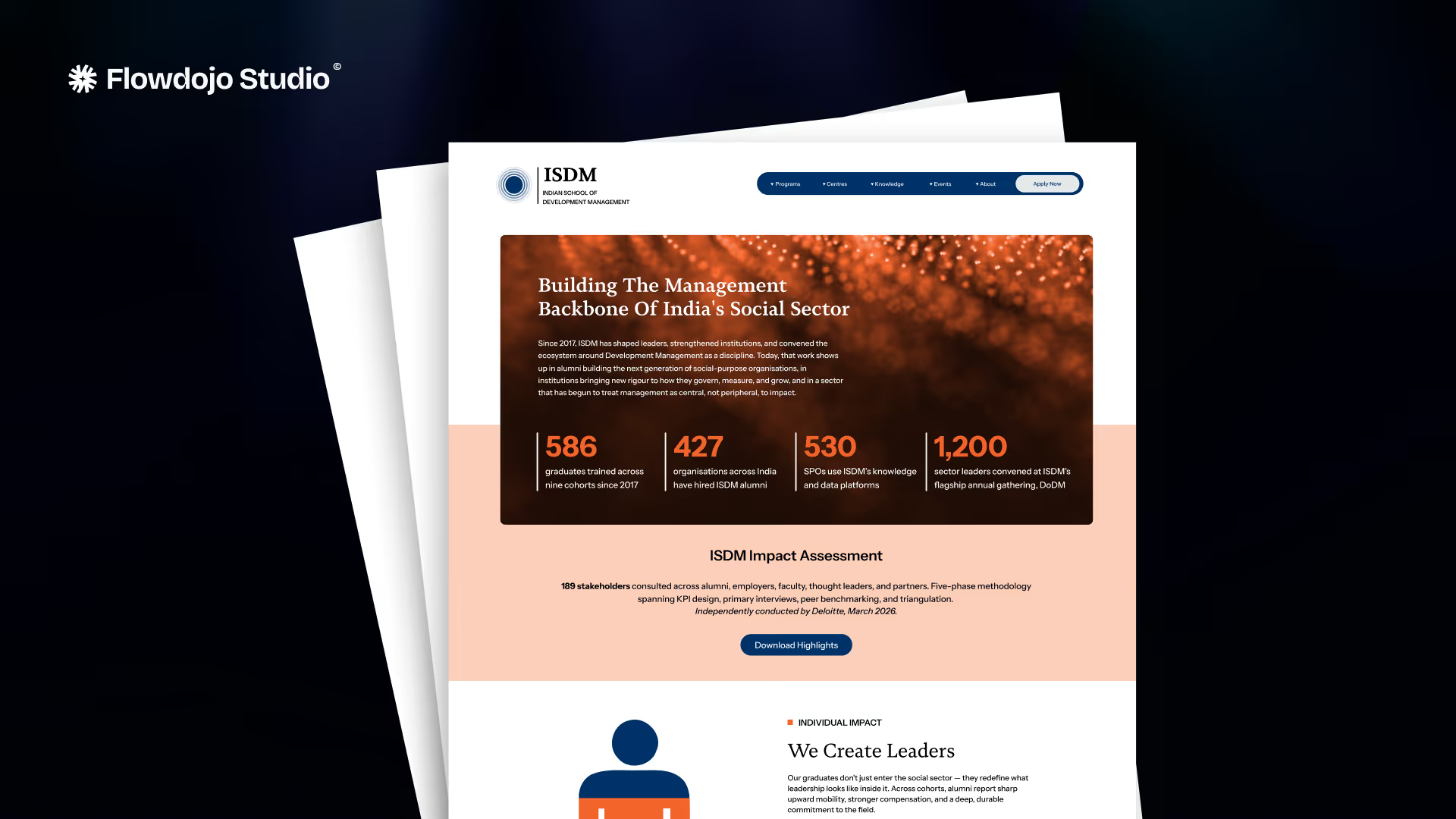
How Flowdojo migrated ISDM's 22-page education site to Webflow with thousands of articles and zero search ranking loss in 60 days. Full migration case study.